If you also felt that the chocolate Easter bunnies was a lot more expensive this year, you were right…
Chart of the month: The Chocolate Crisis. The price ofcocoa surpassed $10,000 a ton for the first time ever, as supply chain constraints impacted the market. Poor harvests on the back of bad weather and crop disease in West African growers, where most of the world’s cocoa is grown, is the largest contributor to the supply crunch.
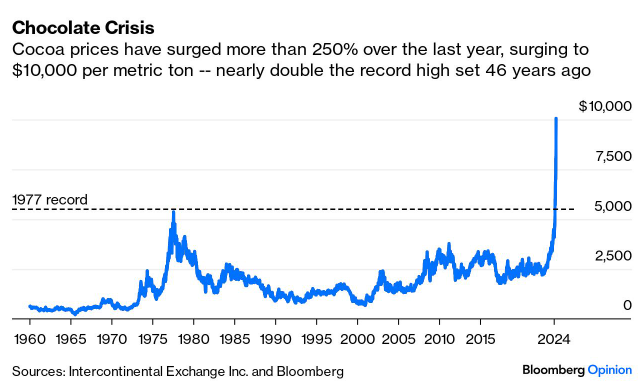
Source: Bloomberg and the FT. Data as of 25 March 2024.
Global Market and Economic Update
- Global equity markets continued their strong run in the face of more persistent inflation and a delay in the expected interest rate cutting cycle. Central banks continue to keep a close eye on economic conditions as sticky inflation has pushed the expectations for the first rate cut out to later in 2024. Sentiment towards risk assets continued to remain strong, with most global equity markets ending in positive territory. The MSCI World Index posted its 4th best first quarter return in thirty years. Emerging markets followed developed market peers higher this month, as the broad market strength filtered through most emerging markets.
- Most developed market central banks kept interest rates unchanged and at over 20-year highs at their second meeting of 2024. Persistent inflationary pressures continue to be front of mind for most central banks, as policy makers keep a watchful eye on the health of the economy. The European Central Bank maintained its interest rates at historically high levels during its March meeting, with the main rate remaining at a 22-year high of 4.5%. Turning to the US, the US Federal Reserve left rates at a 23-year high of 5.5% for a fifth consecutive meeting in March 2024, in line with market expectations. The Bank of England maintained the Bank Rate at 5.25% during its March meeting, its highest level since 2008, as policymakers continued to wait for clearer signals that the country’s persistent inflationary pressures had subsided.
- Developed market inflation numbers produced varying prints this month, with most moving lower, barring the US, where inflation rose unexpectedly. The annual inflation rate in the US moved higher to 3.2% (year-on-year in February) compared to 3.1% in January and above forecasts of 3.1%. Energy costs dropped less than expected, with gasoline, utility gas and fuel prices falling less than expected. In addition to this, prices continued to rise sharply for transportation, adding to the tick up in inflation this month. The United Kingdom’s inflation rate dropped to 3.4% (year-on-year in February 2024), down from the 4% level recorded in both January and December and falling below the market expectation of 3.5%. It was the lowest rate since September 2021, driven by a slowdown in price increases for food and non-alcoholic beverages. The consumer price inflation rate in the Euro Area was at 2.6% (year-on-year in February 2024), the lowest rate in three months, but still exceeding the European Central Bank’s target of 2%.
- Turning to unemployment numbers, these continue to remain robust but have ticked higher recently. The unemployment rate in the US rose by 0.2% to 3.9% at the end of February 2024, touching the highest level since January 2022. The unemployment rate in the UK ticked higher to 3.9% at the end of February, ahead of expectations.
South African Market Update
- South African asset classes produced mixed returns this month, with local equities leading the way higher, while SA property and SA bonds declined. Local equities, and particularly the Resource sector, rebounded in March, posting strong gains. On the other hand, “SA Inc” stocks, namely SA Financials and SA Retailers produced poor performance this month. South African property counters moved lower, giving up some of their recent strong performance. South African bonds moved lower this month, trailing cash returns, as the yield curve steepened. The rand strengthened against the major crosses this month.
- The strength in South African equities was largely driven by the Resource sector, which moved higher over the month due to a rebound in performance from gold, diversified miners, and platinum holdings. Harmony Gold (+40.4%), Gold Fields (+22.5%) and Anglogold (+18.1%) produced strong performance on the back of the strong bounce in the Gold price. Other outperformers included Thungela (+16.1%), Glencore (+14.2%), and Anglo-American PLC (+12.6%). Industrials generated a positive return this month, however, the sector lagged the broader market, as SA Retailers came under pressure. Spar (-9.4%), the Foschini Group (-4.8%) and Woolworths (-5.5%) all ended the month in negative territory. Financials produced a negative return this month, primarily due to weakness in the larger banking and insurance counters, including Absa (-9.4%), Sanlam (-5.7%), and Discovery (-11.2%).
- Local bonds ended the month lower, producing a second month of negative returns. Yields continued to tick higher (and prices lower), as concerns surrounding South Africa’s fiscal position as well as the uncertainty of an election year weighed on sentiment.
- Local listed property moved lower this month after a strong start to the year. Index heavyweights Growth Point (-3.8%) and Nepi Rockcastle (-0.6%) moved lower, giving up some of the gains recorded in the first two months of 2024.
South African Economic Update
The RMB/BER business confidence index in South Africa fell for the second straight quarter to 30 in Q1 2024, compared to 31 in Q3 2023, signalling a growing pessimism among businesses. The continued supply constraints, including load-shedding, logistical challenges, and heightened global and domestic policy uncertainty, has kept South African businesses pessimistic about business conditions.
South Africa’s economy avoided a technical recession, as GDP grew quarter-on-quarter by 0.1% in Q4 2023 and grew by 1.2% (year-on-year ending Q4 2023), which was better than market estimates of a 0.9% rise. For historic context, the annual GDP growth rate in South Africa averaged 2.4% from 1994 until 2023, reaching an all-time high of 19.2% in the second quarter of 2021 and a record low of -16.2% percent in the second quarter of 2020.
South Africa’s annual inflation rate rose to 5.6% (year-on-year in February 2024), above market forecasts of 5.5% and moving to the upper end of the reserve bank’s target. The increase was mainly due to higher prices for transport, housing, and utilities. On the back of inflation continuing to be at the upper end of the central bank’s target, the South African Reserve Bank unanimously decided to leave its key repo rate for the fifth time in a row at 8.25% in March, as widely anticipated.
See below for a summary of the key market movements for the month of March:
- The JSE All Share Index (+3.2%) ended March higher, driven largely by the Resources and Industrials indexes.
- The strong performance from South African equities was narrow with Resources (+12.8%) driving the bulk of the performance on the back of strength in the gold and platinum sectors. Industrials (+2.6%)produced a positive return, as the telecoms and pharma sector moved higher. Financials (-3.4%) ended in negative territory, driven lower by the banks and life insurers.
- Listed property (-1.0%) ended the month lower, producing a negative performance and giving up some of the strong performance recorded in the first two months of 2024. Local listed property continues to be the best performing local asset class on a year-to-date basis.
- Local bonds (-1.9%) ended the month lower, following global peers, as investors continued to reconsider the timing of possible future interest rate cuts around most developed markets.
- Cash continues to yield a positive return. Cash delivered +0.6% in March.
- Most of the major developed equity markets ended the month higher. The MSCI World Index delivered a return of +3.3%, which was ahead of emerging market peers.
- Most emerging equity markets moved higher during the month on the back of continued positive sentiment buoying demand for emerging market equities. The MSCI Emerging Markets Index ended the month +2.5% higher in March.
- Most major global equity markets produced positive returns in March, as broad-based positive sentiment filtered through most developed market indices. The Nikkei 225 (+2.6%), Germany’s FSE DAX (+4.4%), the UK’s FTSE 100 (+4.7%) and China’s Shanghai SE Composite (+0.4%) ended in positive territory.
- US equities moved higher in March, continuing their strong run. The tech-heavy NASDAQ 100 (+1.2%) posted a strong return in March, as tech stocks continue to produce strong returns. The S&P 500 (+3.2%) also ended the month higher, as most sectors ended in positive territory.
- In terms of the major commodities, Gold (+8.1%), Copper (+4.2%), Oil (+4.6%) and Platinum (+2.3%) ended the month in positive territory.
- The rand strengthened against most of the major crosses this month. The currency gained ground against the US dollar (+1.3%), pound sterling (+1.4%) and euro (+1.5%) during the month.