Global Market and Economic Update
Global markets continued their downward trend this month, posting another negative performance. Global equity markets recorded their third consecutive negative return this month, as sentiment toward risk assets waned. The “higher for longer” theme continued to dominate in October, as strong economic data, and upside risks to inflation continued to signal to market participants that interest rates may stay higher for longer. Inflation concerns were further exacerbated by the continued conflict in the Middle East. Given the risk-off environment, safe haven assets such as gold and the US dollar strengthened this month, as investors sought refuge in a particularly volatile environment. The risk-off environment did not spare US bonds, as yields continued upwards, recording their sixth consecutive month of increases, leading prices lower.
While most developed market policymakers concluded their meetings in September, the European Central Bank (ECB) held its meeting in October and followed most central banks by keeping interest rates at multi-year highs. This decision not to hike interest rates marked a shift from its 15-month streak of rate hikes and indicated a more cautious “wait-and-see” stance among policymakers. The central bank mentioned that it is determined to ensure inflation returns to its 2% target over the medium term, saying it will maintain interest rates at these elevated levels for a sufficiently extended period until it achieves that objective. As we head into November, where there are a few developed market central bank meetings, all eyes will be on the key decision makers as they grapple with inflation and robust economic data.
Developed market inflation numbers largely remained at similar levels to the prior month, fuelling concerns of inflation remaining “higher for longer”. The annual inflation rate in the US remained at 3.7% (year-on-year to the end of September) from 3.7% in August and above market forecasts of 3.6%. The core inflation rate, however, slowed for the sixth month to 4.1% (year-on-year to the end of September), as key drivers such as shelter, and services continued to decline. China’s consumer prices remained unchanged in September, below market forecasts of 0.2%. The latest data indicated persistent deflationary pressures in the world’s second-largest economy, raising concerns about the sustainability of the economic recovery due to decreased demand. The inflation rate in the euro area declined to 2.9% (year-on-year to the end of September), reaching its lowest level since July 2021 and falling below the market consensus of 3.1%. Consumer price inflation in the United Kingdom remained at 6.7% (year-on-year to the end of September), from 6.7% in the previous month, below the market consensus of 6.8%.
Turning to other key economic data releases this month. The US continued to produce robust economic data in October, leading to concerns of further leeway for the US Federal Reserve to leave borrowing costs at restrictive levels for a prolonged period. The US economy expanded 4.9% (year-on-year in the third quarter of 2023), above market forecasts of 4.3%. The labour market in the US continues to remain tight, with the unemployment rate at 3.8% in September of 2023, slightly above market expectations of 3.7%. Retail sales in the US advanced 0.7% (month-on-month in September), beating forecasts of a 0.3% advance. The data continues to point to robust consumer spending despite high prices and borrowing costs.
South African Market Update
South African asset classes followed global peers lower this month, as local equities came under pressure. South African equities were not spared in the global sell-off and reported a negative return for the month, broadly in line with the emerging market complex. South African bonds defied the global trend and posted a positive return this month and were one of the few local asset classes to end the month in positive territory. The rand strengthened this month, despite a broadly stronger US dollar.
The weakness in South African equities was broad-based, as all sectors produced negative returns. Industrials were the largest laggard as index heavyweight MTN (-19.4%) fell on weak results and concerns around exposure to Nigeria. Further to that, certain rand hedges including Richemont (-3.9%), Prosus (-5.4%) and British American Tobacco (-5.5%) fell on the back of a firmer rand and generally weak global equity markets. Financials produced a negative return this month, however, the return was largely ahead of the broader market weakness. After a robust month in September, Resources produced a significantly weaker October performance, on the back of weakness in platinum and diversified miners. On the other hand, gold counters such as Harmony (+22.7%), Gold Fields (+21.0%) and Anglogold (+13.1%) produced robust returns this month as the gold price moved higher (+6.8%).
Local bonds ended the month higher, as the yield curve bull steepened, with short term yields falling faster than longer term yields. The strength in the SA bond market suggests that investors are becoming more comfortable that the market is pricing in much of the bad news associated with the fiscal outlook.
Local listed property produced a negative performance this month, however, the performance was ahead of the SA equity market. The prevailing risk-off sentiment, coupled with a large decline in the index heavyweights Nepi Rockcastle (-2.8%) and Growthpoint (-1.4%) led the sector lower.
South African Economic Update
The South African Chamber of Commerce and Industry (SACCI) business confidence index fell marginally to 108.2 in September 2023, compared to the August figure of 108.6. Factors such as energy supply constraints and inflation negatively affected sentiment, whereas foreign business-related elements had a positive influence. According to SACCI “the current business climate is not conducive to stimulating overall economic activity”.
Chart of the month: A few “scary” months for global equity markets. After having a strong start to the year, most global equity markets had a tough few months, as most developed equity markets trended lower.
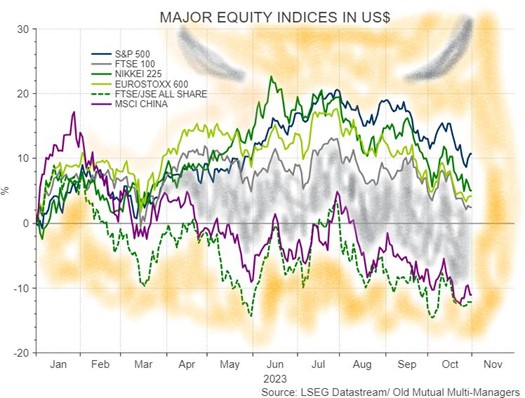
Source: LSEG DataStream/Old Mutual Multi-Managers. Data as of 31 October 2023
See below for a summary of the key market movements for the month of October:
- The JSE All Share Index (-3.4%) ended October lower, as all sectors ended in negative territory. After a tough couple of months, The JSE All Share is now in negative territory on a year-to-date basis.
- The weak performance from South African equities was broad-based, with all sectors posting negative performance. Financials (-2.0%), Industrials (-4.5%)and Resources (-3.2%) produced declines this month as negative global sentiment filtered through the local equity market.
- Listed property (-3.0%) ended the month lower, producing a weak performance in the face of a tough risk-off environment.
- Local bonds (+1.7%) ended the month higher, as the yield curve moved lower (and prices higher), particularly in the belly of the curve as demand for medium-dated and long-dated bonds increased.
- Cash continues to yield a positive return. Cash delivered +0.7% in October and is the best performing local asset class on a year-to-date basis.
- Most of the major developed equity markets ended the month lower this month. The MSCI World Index delivered a return of -2.9%, which was ahead of emerging market peers.
- Most emerging equity markets moved lower during the month, on the back of waning appetite for risk assets. The MSCI Emerging Markets Index ended the month -3.9% lower in October.
- All major global equity markets produced negative returns in October. The UK’s FTSE 100 (-4.3%), Germany’s FSE DAX (-3.9%), Japan’s Nikkei 225 (-4.6%) and China’s Shanghai SE Composite (-3.1%) ended the month in negative territory.
- US equities moved lower in October, following global peers. The tech-heavy NASDAQ 100 (-2.0%) posted a negative performance as mega-cap technology stocks came under pressure, however, on a year-to-date basis the performance is still very strong. The S&P 500 (-2.1%) also ended the month lower, as most sectors ended in negative territory.
- In terms of the major commodities, Gold (+6.8%) and Platinum (+1.8%) posted strong performance in October, rebounding from the weak performance recorded in September. On the other hand, Oil (-8.3%)ended the month significantly lower.
- The rand strengthened against most of the major crosses this month. The currency gained ground against the US dollar (+0.5%), euro (+0.7%), and the pound sterling (+1.1%) during the month.
*All data is sourced from Morningstar Direct as of 31 October 2023. The performance of South African asset classes is quoted in Rands and the performance of global asset classes is quoted in US Dollars.