Global Market and Economic Update
Global markets moved higher in November, as market participants anticipated a slowdown of the interest rate hiking cycle by the major central banks. The positive investor sentiment led to significant positive moves in most global equity market indices, providing investors with some reprieve from a tough year. There has, however, been a continued focus on the effects of persistently higher interest rates on the health of the global economy. During the month, emerging markets outperformed developed market peers, as Chinese equities rebounded from their October lows. Nevertheless, China continues to face multiple headwinds, including its strict COVID-19 policy, which led to public protests around the country this month.
Inflation remains elevated; however, some developed market inflation prints have come in lower than expected. The annual inflation rate in the UK jumped to 11.1% (year-on-year to the end of October), from 10.1% in September, much higher than market forecasts of 10.7%. This is the highest inflation rate in the UK since October 1981. Household services, and specifically gas (which has risen 128.9% year-on-year), provided the largest pressure to the headline inflation number. On the other hand, the annual inflation rate in the Euro area eased to 10% (year-on-year to the end of November), from a record high of 10.6% in October, beating market forecasts of 10.4%. In addition, China’s annual inflation dropped to 2.1% (year-on-year to the end of October), from 2.8% in the prior month, below market consensus estimates of 2.4%, which was the lowest figure since May.
Central banks continued to aggressively hike interest rates this month, however, the tone from global central banks has softened, with the US Federal Reserve indicating that they may scale back the pace of their interest rate hikes in the coming meetings. During the month, the Federal Reserve raised the target range for the federal funds rate by 0.75% to 3.75%-4.00%, marking the sixth consecutive interest rate hike, and the fourth straight 0.75% increase, pushing borrowing costs to the highest level since 2008. The Bank of England raised interest rates by 0.75% to 3.00% during its November meeting, the largest interest rate hike since 1989, increasing the cost of borrowing to the highest level since late-2008. On the other hand, the People’s Bank of China (PBoC) kept its key lending rates unchanged for the third straight month at the November meeting, amid continued downward pressure on the Chinese Yuan and a slowdown in economic activity due to rising COVID cases and restrictions, or lockdowns, in several cities.
South African Market Update
South African asset classes followed global peers higher, with the equity market producing double digit returns this month. The positive market moves were broad-based across the South African opportunity set.
South African equities ended November meaningfully higher, posting the third best monthly performance since the global financial crisis. SA equities continue to be one of the best performing global equity markets over the past year. Resources produced a robust return in November on the back of a firmer commodity price complex. Industrials posted positive performance, ahead of the broader market, given the significant upward moves posted by Naspers and Prosus, following a bounce in Tencent this month. Financials produced a positive return, albeit lagging the broader market, however, the sector continues to be the best performing area of the local equity market over the past twelve months.
Local bonds ended the month higher, and fared better than their developed market peers, supported by the stronger rand. Yields moved significantly lower (and prices higher), as expectations of a moderation in interest rate hikes continued.
Local property had a strong November, following the strong performance in October. However, the property sector continues to be the only South African asset class with negative year-to-date performance.
South African Economic Update
South Africa’s annual inflation rate moved higher to 7.6% in October, above market expectations of 7.4%, and above the upper limit of the South African Reserve Bank’s target range of between 3%-6%. Core inflation continued to remain elevated and moved to a five-and-a-half year high of 5% in October. The RMB/BER business confidence index in South Africa fell for the third consecutive quarter to 38 in the fourth quarter of 2022, the lowest since the beginning of 2021. In response to the elevated inflation, the South African Reserve Bank (SARB) raised interest rates by 0.75% to 7.00%, pushing borrowing costs up to a five-year high.
South Africa’s unemployment rate was at 32.9% in the third quarter of 2022, down from 33.9% in the prior period, and below market consensus estimates of 33.4%. The country’s youth remain at risk in the labour market, with an unemployment rate of 45.5% in young people aged between 15 and 34.
During the month, global rating agency Fitch released its rating decision for South Africa, keeping its long-term rating unchanged at “BB-” with a stable outlook. Whilst the outlook is stable, the rating agency pointed out that the country’s growth potential remains low, given the constraints with transport, infrastructure, and electricity.
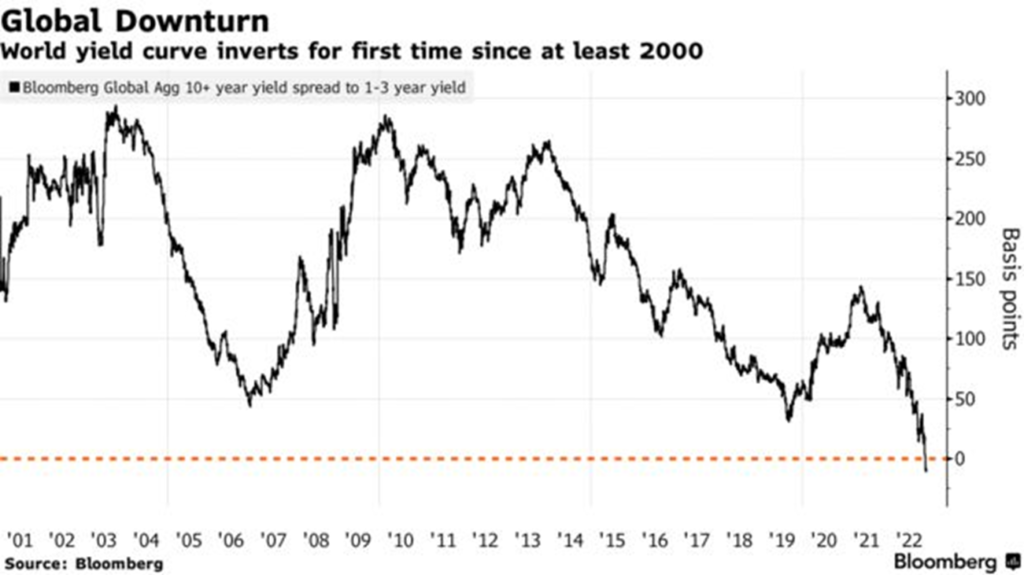
Chart of the month: Global bonds joined US peers in signaling a possible recession, with a gauge measuring the worldwide yield curve inverting for the first time in at least two decades.
See below for a summary of the key market movements for the month of November:
- The JSE All Share Index (+12.3%) ended November significantly higher, posting a double-digit return, with all sectors ending the month meaningfully higher.
- The positive performance from the SA equity market was broad based, with all sectors posting a positive return. Industrials (+14.0%)delivered strong performance, ahead of the broad market, given the returns from Prosus (+39.0%) and Naspers (+38.7%) over the month. Financials (+4.9%)and Resources (+16.0%) alsorose strongly over the month. Resource shares Kumba Iron Ore (+39.8%), Anglogold (+27.7%) and Gold Fields (+26.9%)were among the top performers in the ALSI Top 60 this month.
- Listed property (+6.3) ended the month higher, however, the asset class continues to have negative year-to-date performance.
- Local bonds (+3.9%) ended the month higher, as bond prices on the longer end of the curve in particular rose, as yields fell in response to expectations that there will be a moderation in interest rates.
- Cash delivered a positive return of +0.5% in November.
- Most of the major developed equity markets ended the month significantly higher, following the strong market moves seen in October, capping off two strong months for equity markets. The MSCI World Index delivered a return of +7.0% in November, lagging emerging market peers over the month.
- Emerging market equities outperformed developed market equities in November, as Chinese equities led the emerging market complex higher over the month. The MSCI Emerging Markets Index ended the month 14.9% higher in November.
- All major global equity markets produced robust returns in November, with some producing double-digit returns. The UK’s FTSE 100 (+10.8%), Germany’s FSE DAX (+13.2%) and Japan’s Nikkei 225 (+8.0%) all delivered positive performance for the month. China’s Shanghai SE Composite (+11.3%) moved meaningfully higher this month.
- US equities ended the month higher in November. The US equity rebound was relatively broad based, with both the S&P 500 (+5.6%)and the tech-heavy NASDAQ 100 (+5.6%) ending the month higher.
- In terms of the major commodities, Oil (-9.9%) fell meaningfully, while Gold (+7.0%) and Platinum (+9.6%) ended the month higher.
- The rand performance was firmer against most of the major crosses this month. The currency gained ground against the US dollar (+7.5%), euro (+3.6%) and the pound sterling (+4.3%) during the month.