Global Market and Economic Update
Global markets staged a rebound in July; however, the final reported moves masked the volatile markets experienced during the month. The focus for investors shifted from rising inflation to slower economic growth and the expectations that the US Federal Reserve will not have to raise its policy rate as much as previously expected, all of which led to elevated volatility in July. Inflation continues to be an overriding theme for markets, as inflation prints continue to come in higher than expected, which has resulted in continued pressure on central banks to balance the trade-off between growth and inflation.
The annual inflation rate in the US accelerated to 9.1% (year-on-year to the end of June), the highest since November 1981, and above market forecasts of 8.8%. Meanwhile, in the EU, inflation increased to a new record high of 8.9% (year-on-year to the end of June), also ahead of market expectations. The annual inflation rate in the UK increased to 9.4% in June of 2022, which is the highest rate since 1982, and slightly above market forecasts of 9.3%.
Inflation prints spurred central banks to continue aggressive monetary tightening, with the US Federal Reserve raising the target range for the fed funds rate by 0.75% (to 2.25% – 2.5%) during its July 2022 meeting, the fourth consecutive interest rate hike. The European Central Bank hiked interest rates by 0.5% during its July 2022 meeting, the first increase since 2011. This ended a period of eight years of negative interest rates.
US GDP for Q2 2022 came in below expectations, falling 0.9% quarter on quarter in Q2 2022, following a 1.6% drop in Q1, leading the US into a technical recession. Despite this, the official definition of a recession in the US involves other factors, including conditions of employment. Therefore, it is unlikely that the US is officially in a recession given that the labour market is still strong and that the negative Q1 2022 number was primarily a function of higher-than-normal imports.
South African Market Update
South African asset classes followed their global peers higher in July, as markets rebounded strongly from a tough month in June.
South African equities moved higher in July, supported by positive performance across all local equity sectors. Resources managed to end the month in positive territory, despite commodity prices coming under pressure slightly due to concerns around slowing global growth and the increased possibility of a recession. Industrials and Financials, meanwhile, both delivered respectable performance in July.
Local bonds rebounded strongly during July, after a difficult month in June. The yields on the shorter end of the curve ended higher on the back of expectations of further interest rate hikes, whilst the longer end of the curve ended lower on the back of attractive valuations as well as the global risk-on environment.
Property rebounded strongly and was the best performing local asset class in July. Large index constituents including Redefine and Growthpoint delivered strong performance over the month.
South African Economic Update
Local inflation increased to 7.4% (year-on-year to the end of June), above market expectations of 7.2% and well above the upper limit of the South African Reserve Bank’s (SARB) target range of 3%-6%. It was the highest reading in 13 years as prices continued to accelerate, mostly for the transport and the housing and utilities categories.
The SARB’s Monetary Policy Committee raised interest rates by 0.75% at their meeting in July, which was slightly more than the expected 0.50% hike. This raised the repo rate to 5.5%, with the SARB signalling that further interest rate increases may be on the cards. This is the fifth consecutive rate hike since November last year, delivering the biggest increase in borrowing costs in almost 20 years.
Whilst SA continues to have inflation at the top of its agenda, there was also some good news over the month. Cyril Ramaphosa announced that Eskom will develop a feed-in tariff system to buy energy from households and businesses with rooftop solar. This will allow procurement of independently produced electricity to assist with reducing load shedding.
Chart of the month: Fears around a deteriorating global growth outlook will likely result in a paring back in expected demand for some of SA’s key export commodities. Balancing the view that the commodities seem to be selling off on growth concerns is the role that China plays in the global demand for commodities. This could be seen as good news for inflation prints going forward.
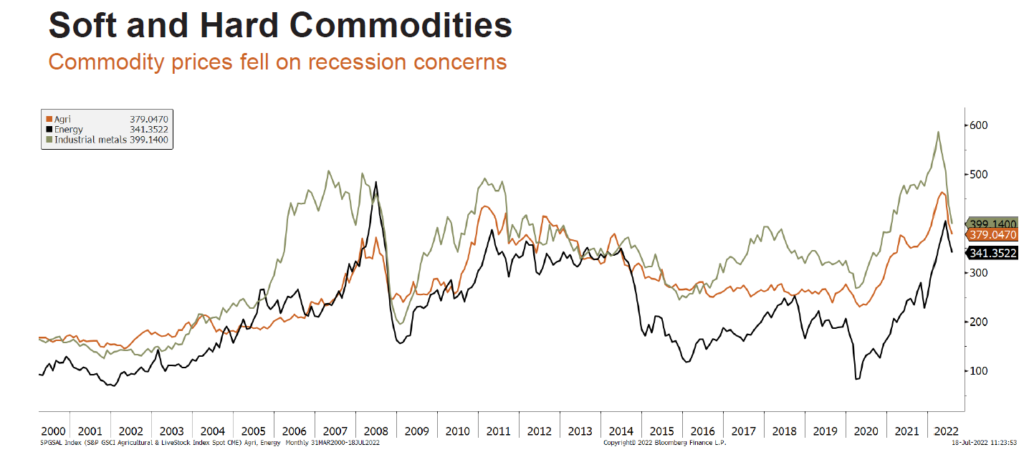
Source: Fairtree Asset Management, Bloomberg. Data as at 18 July 2022.
See below for a summary of the key market movements for the month of July:
- The JSE All Share Index (+4.2%) ended the month notably higher after declining sharply in June.
- The SA Equity rebound was relatively broad based with Industrials (+5.8%) leading the rebound. Financials (+3.9%) and Resources (+1.3%) also ended the month in positive territory.
- Listed property (+8.8%) ended the month considerably higher and erased most of the losses of the previous month. Redefine (+11.2%) and Growthpoint Properties (+9.7%) led the rebound in property over the month.
- Local bonds (+2.4%) also ended the month higher, as local investors moved into longer dated bonds on the back of attractive valuations.
- Cash delivered a positive return of +0.4% in July and is the best performing local asset class year-to-date, given the volatility that we have seen so far in global markets in 2022.
- Most of the major developed equity markets ended the month in positive territory after a tough June. The MSCI World Index delivered a return of +8.0% in July, well ahead of its emerging market peers.
- Emerging market equities underperformed developed market equities slightly, with Chinese equities being the largest detractor. The MSCI Emerging Markets Index ended the month down -0.2%.
- Most of the major global equity markets rebounded strongly after the June slump and ended the month in positive territory. The UK’s FTSE 100 (+3.9%), Germany’s FSE DAX (+2.9%) and Japan’s Nikkei 225 (+7.1%) all delivered positive performance for the month. China’s Shanghai SE Composite (-4.9%) was under significant pressure in July, reversing some of the positive performance that came in June.
- US equities performed well in July, after a difficult start to the year. The S&P 500 (+9.2%) rose strongly along with the technology-heavy NASDAQ 100 (+12.6%).
- In terms of the major commodities, Oil (-4.2%), Platinum (-2.0%) and Gold (-3.5%) all ended the month lower.
- The rand performance was mixed for the month against most of the major currencies. The currency lost ground against the US dollar (-1.7%) and pound sterling (-1.9%) but gained against the euro (+0.8%).
All data is sourced from Morningstar Direct as at 31/07/2022. The performance of Local Market Indices and Local Market Sectors is quoted in rands and the performance of Global Market Indices and Commodities is quoted in US dollars.