Global Market and Economic Update
Global markets continued to sell off over the month as rising interest rates and persistently higher inflation point to an especially negative outlook for short-term asset prices. Increasing fears of a potential global recession further contributed to elevated volatility across both developed and emerging markets as investors remain sceptical of the ability of central bankers to balance the trade-off between growth and inflation.
The US Federal Reserve hiked interest rates by a further 0.75% at the meeting in early June to follow the 0.50% increase in May. Inflation continues to be less transient than some market pundits were initially suggesting as global supply chain shortages persist and energy and food prices remain elevated due to the ongoing Russian invasion of Ukraine. The US inflation print came in at 8.6% (year-on-year to the end of May), the highest reading since 1981 while Eurozone inflation registered 8.1% and UK inflation hit a new multi-decade high of 9.1%.
Global equities experienced another turbulent month as all major developed markets ended lower. The S&P 500 fell 8.3% in June and recorded its largest first-half contraction since 1970. Emerging Markets were relatively stronger over the month as the easing of COVID-19 restrictions helped Chinese equities move higher in June.
South African Market Update
All major SA asset classes were under pressure over June with only cash generating a marginally positive return over the month. Foreigners remained net sellers of both SA equities and bonds while the rand ended the month around 4.1% weaker against the US Dollar after breaking through some resistance at R16/$.
South African equities were down as the Resources and Financials sectors came under significant selling pressure. All the main commercial banks and insurers were down by more than 10% over the month while the leading materials companies gave back much of their gains from the start of the year. Industrials also struggled but were rescued by the re-rating of Naspers and Prosus following the announcement of an open-ended buyback programme through the intended unwinding of their holding in Tencent.
Local bonds were also not spared and were weaker over the month after posting positive returns in May. Yields on the benchmark 10-year SA government bond moved close to 11% as pressure in global fixed income markets, as well as uncertainty around the domestic outlook for inflation, continued to concern both local and foreign investors. Inflation-linked bonds faired relatively better but were also down over the month.
Local listed property had an especially challenging month and continues to trend lower as inflation and bond yields move higher.
South African Economic Update
Local inflation increased to 6.5% (year-on-year to the end of May) and moved through the upper limit of the Reserve Banks’ 3% – 6% target band. Food and transport were the main contributors to the higher print with these costs expected to continue to apply upward pressure on inflation given the fallout from the ongoing Russian invasion of Ukraine.
SA consumer confidence, as measured by the FNB/BER Consumer Confidence Index (“CCI”) dropped to its lowest level since June 2020. Excluding the COVID-19-induced Level 5 lockdown period during the initial outbreak of the pandemic in South Africa, the CCI is currently at its lowest level since 1986.
SA growth still faces significant challenges as higher global interest rates and inflation adversely affect growth prospects but there was also some good news over the month. Stats SA reported that growth for the first quarter of the year came in ahead of expectations at 1.9%. The country also continues to benefit from a strong trade surplus, as the amount by which exports exceed imports increased to over R28bn in May from a revised R16bn the previous month.
Chart of the month:
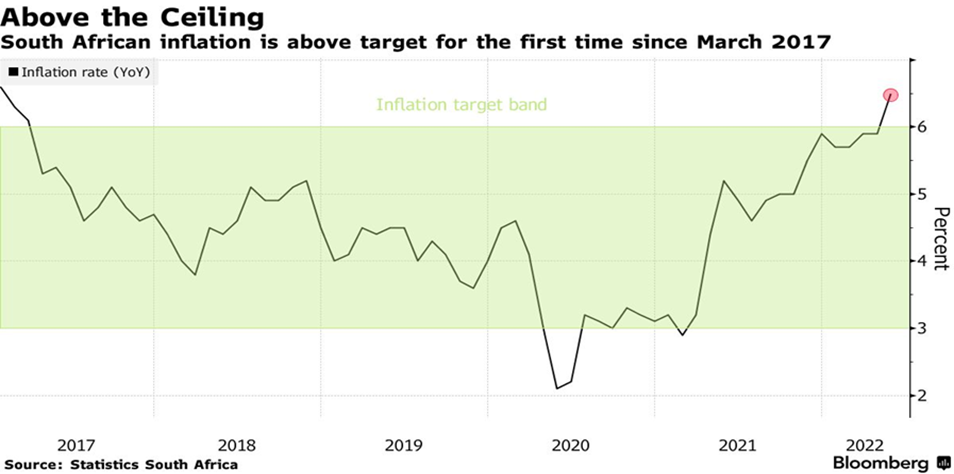
See below for a summary of the key market movements for the month of June:
- The JSE All Share Index (-8.0%) ended the month sharply down after being relatively flat in May.
- The SA Equity sell off was relatively broad-based with Resources (-16.3%) and Financials (-13.3%) coming under considerable pressure over the month. The major banks and insurers erased gains from the previous month with Sanlam (-21.6%) and Absa (-15.8%) among the bottom 10 market performers in June.
- Industrials (+0.9%) was the only sector that delivered positive performance over the month. This does however mask the drawdowns in the broader sector and is primarily attributable to the recovery in both Naspers (+38.1%) and Prosus (+30.1%) which were the top-performing companies in June.
- Listed property (-10.3%) also came under pressure in June as SA REITs continued to struggle. Growthpoint Properties (-14.4%) was a leading detractor over the month.
- Local bonds (-3.1%) also ended the month lower as local investors continue to price in potentially higher than expected SA Inflation.
- Cash was the only positive SA asset class over the month and delivered a return of +0.4% in June.
- Most of the major developed equity markets ended the month in negative territory after a slight reprieve in May. The MSCI World Index delivered a return of -8.6% in June and largely followed the market downturn seen since the start of the year.
- Emerging market equities performed relatively better than their developed market counterparts with an especially strong recovery from Chinese listed equities. The MSCI Emerging Markets Index was however still down over the month anddelivered a return of -6.6% in June.
- The UK’s FTSE 100 (-9.0%), Germany’s FSE DAX (-13.3%) and Japan’s Nikkei 225 (-8.2%) all delivered negative performance for the month. China’s Shanghai SE Composite (+6.1%), which has been under significant pressure on a year-to-date basis, experienced another positive month following the rebound seen during the previous month in May.
- US equities endured another turbulent month to close out an especially difficult quarter. The S&P 500 (-8.3%) continued to fall along with the selloff in the technology-led NASDAQ 100 (-8.9%) where growth and earnings expectations continue to be revised by investors.
- In terms of the major commodities, the move in Oil (-6.5%) was more muted than in previous months.
- Both Platinum (-5.8%) and Gold (-1.2%) ended the month lower.
- Rand performance was also weaker for the month against all the major crosses. The currency lost ground against the US dollar (-4.1%), pound sterling (-0.5%) and the euro (-1.7%).