Global Market and Economic Update
In March both market and news headlines were dominated by the war in Ukraine. Developed markets were quick to introduce sanctions against Russia and individuals linked to Putin. During the month, markets tried to digest the impact that sanctions would have on both companies and economies worldwide. Most market participants questioned the impact that higher commodity prices (oil and wheat in particular) would have on inflation as well as global growth expectations.
Global equity markets remained volatile and ebbed and flowed on the news being reported from Ukraine. Developed market equities bounced back strongly in March – for the most part to levels above that of the beginning of Russia’s invasion of Ukraine. The US Equity market (S&P 500) ended up 3.7% for the month (after being down 4.5% in the month). Emerging markets ended lower for the month driven by losses in China.
Yields on global bonds continued to increase in March as inflation numbers surprised on the upside. The US Federal Reserve (Fed) approved a 0.25% rate hike – the first increase since December 2018. Fed officials also signalled an aggressive interest rate hiking path ahead in a bid to control inflation expectations.
While the recovery in equity markets appears to be at odds with a more hawkish US Fed, investors are reverting to the equity market for inflation protection.
The hawkish Fed stance could negatively impact economic growth. The Fed is in a difficult spot having to manage inflation expectations without sending the US into a recession.
South African Market Update
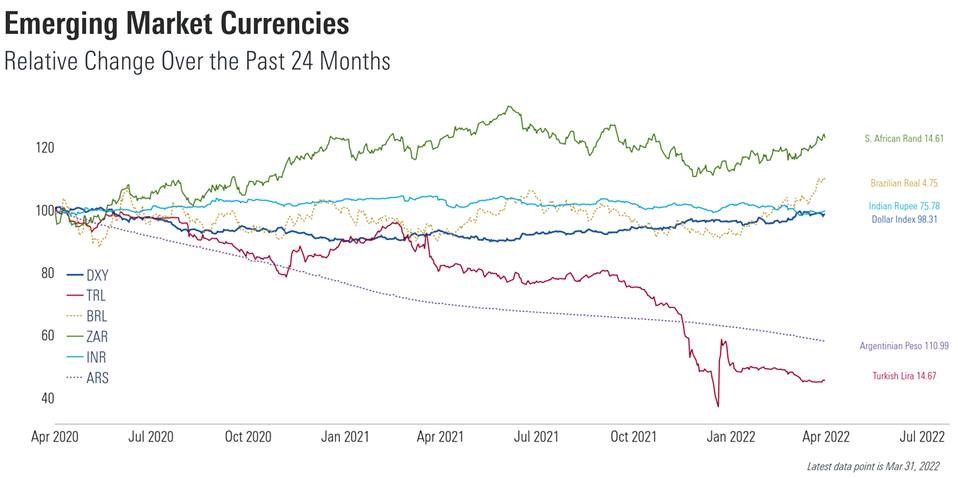
South African assets held up well with bonds and equities outperforming their Emerging markets counterparts by 2.8% and 2.3% respectively. The rand performed strongly in line with most other commodity currencies.
South African Banks were the main drivers of returns for local markets in March. First Rand, Capitec, Investec and Standard Bank were some of the top-performing stocks for the month.
Naspers and Prosus were dealt another blow during the month when news broke that Tencent could expect a significant fine due to breaking anti-money-laundering rules. Morningstar wrote a great piece on Naspers that you are welcome to share with clients:
- Weighing up Naspers — Naspers ‘bulls’ are more likely to believe that negative sentiment is driving markets while ‘bears’ are more likely to believe that weaker than expected fundamentals are finally catching up. We share our views.
Resources also closed the month in the red.
Local bonds had a positive month despite the aggregate yield on South African bonds increasing by 4bps for the month. The yield curve flattened with the short end of the curve increasing and the long end coming down.
While the local listed property had a volatile month, the sector ended the month in positive territory. The sector was able to post strong returns despite initial concerns about the war’s impact on other central and eastern European countries.
The rand rallied and performed positively against major developed market currencies over the month, strengthening against the US dollar, the euro, and the pound sterling.
South African Economic Update
SA headline CPI was unchanged at 5.7% year-on-year for February. Inflation surprised to the downside due to the decline in medical insurance prices (decreasing from 5.9% to 3.6% – the lowest in over 13 years) which, together with slightly lower fuel inflation, offset the increase in other categories. Food and non-alcoholic beverages posted the largest increase – from 5.7% in January to 6.4%.
After the South African Reserve Bank’s (SARB) Monetary Policy Committee (MPC) meeting in March, the MPC hiked the repo rate to 4.25% – its 3rd consecutive 25bp increase. Two of the five MPC members had voted to raise the repo rate by 50bp – the first time a 50bp move was favoured by any MPC member in at least four years.
The MPC’s inflation forecast for 2022 was raised by 0.9% (to 5.8%) due mainly to a material increase in the price of fuel and, to a lesser degree, food. The country’s GDP growth forecast for this year was also revised higher as the fourth quarter of 2021 surprised to the upside and the first quarter of 2022 also appears to be strong.
Chart of the month:
Below is a summary of the key market movements for March:
· The JSE All Share Index (+0.01%) ended the month flat, outperforming other major emerging equity indices.
· Local equity sectors were led by the strong performance from Financials (+12.0%), while Industrials (-4.3%) and Resources (-1.1%) ended the month lower.
· Listed property (+5.1%) ended the month in positive territory.
· Local bonds (+0.45%) ended the month higher. The asset class was offering yields above the middle of the inflation target, which helped to keep performance positive.
· Cash delivered a stable return of +0.4% for the month.
· Most of the major developed equity markets ended the month higher, amid concerns of persistently elevated inflation and potentially higher interest rates in major developed markets. The MSCI World Index delivered a return of +2.8%% for the month.
· Emerging market equities also delivered negative performance. The MSCI Emerging Markets Index delivered a return of -2.2% for the month.
· Performance in the major equity markets was mixed for the month. Germany’s FSE DAX (-1.3%), UK’s FTSE 100 (-0.5%) and China’s Shanghai SE Composite (-6.5%) all delivered negative performance for the month, while Japan’s Nikkei 225 (+0.4%) was largely flat.
· US equities delivered positive performance, with the NASDAQ 100 (+4.3%) and the S&P 500 (+3.7%) ending the month in positive territory.
· In terms of the major commodities, Oil (+6.9%) had another strong month, as the combination of geopolitical tensions and rising demand for Brent Crude drove the price higher. Platinum (-7.5%) also ended the month lower, while Gold (+1.7%) and Copper (+3.7%) ended the month higher.
· The rand performed well against the major developed market currencies for the month, strengthening against the US dollar (+5.5%), the euro (+6.7%), and the pound sterling (+7.5%) over the month.
*All data is sourced from Morningstar Direct as at 31/01/2022. The performance of South African asset classes is quoted in rands and the performance of global asset classes is quoted in US dollars. Past performance is not an indication of future returns. For illustrative purposes only and not indicative of any investment.